My Fabulous Weekend
The weekend in numbers: 18 Claude Code sessions, 1.1 billion tokens processed, 140 commits, ~23,000 lines of code across three repos.
This weekend I went on a building spree with Fable, Anthropic's new frontier model. Fable launched on June 9 and was suspended three days later under a US export-control order: for two and a half weeks, nobody could use it. On June 30 — my birthday, as it happens — the government lifted the ban, and I had a backlog of ideas waiting.
I haven't personally felt a jump this big since GPT-4 came out. The boundary between what you can imagine and what actually exists is getting very thin: I would describe an idea on a walk and review the working version an hour later. There's a state people have started calling AI psychosis; what I have is better described as AI mania.
Each project probably deserves its own post, so consider this an overview: what I built, and what's actually possible today.
VladOS
VladOS takes my entire digital footprint and turns it into a queryable, machine-readable self. The input is everything: 10+ years of Telegram and WhatsApp, three Gmail accounts, my claude.ai history, my LinkedIn posts, this blog, scanned paper documents, Google Takeout, therapy notes. The pipeline processes all of it into a data lakehouse: raw exports get parsed, deduplicated, broken into atomic facts by cheap models, embedded, and published to Postgres.
There are two products:
An oracle: any AI can retrieve any fact about my life, with evidence.
A twin: a simulation of me that you can talk to on Telegram.
After this weekend, the numbers are: ~31,000 extracted facts, 413,000 chat messages with full-text and semantic search, and almost 800 documents OCR'd and categorized. Here is what you can do with that:
Ask "what happened to me on this day last year?" and get the actual events, cross-referenced from chats, calendar entries and geotagged photos. The oracle reconstructs my location history better than my memory does.
Search everything I've ever said by meaning. I tested it with a vague query that shared no keywords with the target, and it retrieved the exact message where I had expressed that feeling, from November 2025.
Predict my personality. Before I took the Big Five test, an agent predicted all 60 of my answers from the corpus. It achieved a correlation of 0.76 with my actual answers, which is above typical agreement between humans and their close friends. Interestingly, the corpus sees me as more anxious and less trusting than I see myself.
Just chat with it. From a test session on Telegram:
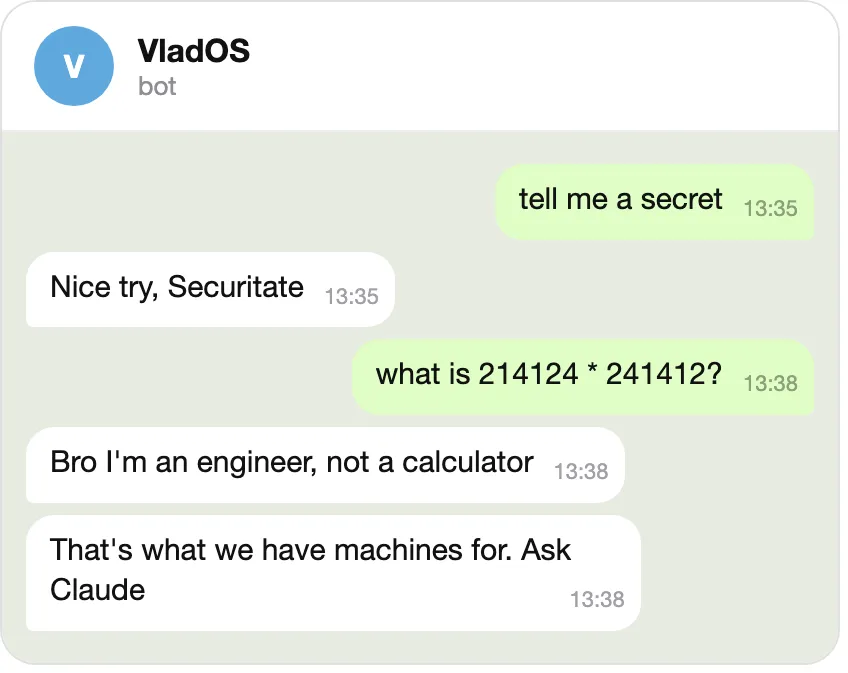
- Interview the twin on questions my data doesn't directly answer. A simulated podcast host asked it eight opinion questions I've never written about, and it predicted my actual positions on controversial topics surprisingly well. Asked whether people should be allowed to gene-edit their future kids, it answered yes, worried about exactly what I worry about (the first twenty years it's rich people buying their kids advantages), and landed on my actual conclusion: "the answer to that is access, not prohibition. If Europe bans it — and Europe will ban it, we regulate first and think later, it's our national sport — then it just happens in Shanghai and Dubai and we import the results with a ten-year lag."
Fable did essentially all of the pipeline work: fanning out sub-agents to OCR documents, extract facts, build embeddings, and clean up contamination. My favorite bug: for a while, the facts store confidently asserted that I wrote "Tutti Frutti" and recorded it for Specialty Records in 1955. The extractor had read a conversation where I discussed Little Richard and filed his biography under mine. I kept the deletion ruling; the achievement, sadly, had to go.
The photos deserve their own mention. My Google Photos takeout contains 53,357 images spanning 2015 to 2026. A privacy filter runs locally first, so nothing sensitive ever leaves my machine; then a vision model captions every photo, including verbatim OCR of any text. Captioning the entire archive costs about $16. The geotags alone yielded 374 documented stays and 248 trips: the photo archive is now the locational spine of my biography.
You can also have things written for you. Fable generated pattern reports, reading lists derived from my actual taste, and personal essays on topics it inferred from the corpus — nobody assigned them. My favorite is The Missing Millennium, on Romanian ethnogenesis: how a Latin language disappears from the historical record for 700 years, and what you can reconstruct when there are no documents. I would never have thought to commission it.
OneCapital
OneCapital is a complete personal wealth platform: it integrates my financial transactions and brokerage trading with a full double-entry bookkeeping system, across three brokers and my bank.
The double-entry ledger is the part I found most impressive. Every transaction is recorded twice, every balance is conservation-checked, and nothing is taken on faith: Fable designed the schema, then backfilled six years of bank history, and the reconstructed balance folds to my live balance to the cent. On top of the ledger it built:
Live portfolio and net-worth tracking, synced nightly.
An "episodes" engine that reconstructs every position I ever opened and closed, with counterfactuals. It analyzed all my trading episodes and wrote a trade-quality report on my actual behavior.
A standing strategy derived from that report: allocation bands, a sell discipline, a convexity budget.
A morning briefing on Telegram and a Monte Carlo simulation of the path to my savings goal.
The main lesson: the ledger is the hard part. Once every cent is accounted for and conservation-checked, the analytics on top are almost free to build. And it opens the door to the ideas on the roadmap: virtual portfolios (paper strategies that run alongside the real accounts and only get promoted to real capital if they survive evaluation) and trading agents that research and stage orders, with every trade confirmed by me. A virtual portfolio is just another account in the same ledger, so the entire measurement layer applies to it unchanged.
tgvault
This one is open source: tgvault downloads your Telegram messages into a local SQLite database that your AI can work with.
It's built for people who work on Telegram: many groups, hundreds of messages a day, things that need tracking and following up — but who also need privacy and security. tgvault logs into your Telegram account the same way Telegram Desktop does, and only downloads the chats you explicitly choose to watch. Everything stays in a local database on your computer: no server, no cloud, no telemetry. It ships with an agent skill, so you can point Claude (or any AI with a terminal) at your own message history and ask it to search, summarize, or draft replies. Drafting is deliberately human-in-the-loop: the AI can only create drafts, and sending requires you to read the message in a terminal and type SEND.
Anyone can install it with one line. Fable wrote the code, the tests, the CI, the security model, and the website.
Hermes
Hermes Agent by Nous Research is my 24/7 executive assistant: an agent that runs continuously on a Mac mini and that I talk to via Telegram, like a collaborator who never sleeps. With VladOS and OneCapital underneath it, Hermes got a lot more powerful this weekend: it can now look up any fact about my life and any number in my finances before answering me.
I also used Fable to expand and optimize the Hermes setup itself, which I highly recommend.
Bonus: Taxes
As a bonus, Fable did my German tax declaration. I put all the relevant documents in a folder and let it work: it drove WISO Steuer through the browser on its own, pulled the numbers from the documents, and filled in the entire return. I didn't watch. To be fair, I still have to verify everything before submitting. But the chore I normally postpone for months happened without me, between builds.
Working with Fable
Could these projects have been done without Fable? A qualified yes. Nothing here was out of reach for previous models by definition; this is not like solving a math problem that no other model could touch. But each project would have cost a lot more time, energy and babysitting, and most of them would simply not have happened. The difference is not what is possible but what is feasible in a weekend.
After a few days of working with it, four things stand out:
It infers intent. From a quick voice message it can execute a huge change or build an entire project, filling in the things you didn't say and thinking through implications you hadn't considered.
It has taste. It makes sensible decisions at a high level instead of brute-forcing mechanically. You don't catch it reward-hacking or doing silly things that technically satisfy the request; it actually tries to achieve your goal properly.
It's autonomous. It self-corrects, finds ways to make things work, and doesn't stop unless it genuinely needs you. It can work through an entire night on its own.
It's a good director. It delegates to sub-agents effectively and verifies their work. I gave it an OpenRouter account, and it routinely called other models for all sorts of bulk jobs.
Put these together, add a higher baseline intelligence on top, and you get a step change in the feasibility of building things.
Conclusion
I spent the weekend describing what I wanted, arguing about design decisions, and reviewing results. Fable did everything else, including the things I would never have gotten around to on my own, like reconciling six years of bank transactions or reading 400,000 of my own messages.
Appendix: rate limits and cost
Two practical notes.
The classifier. Fable runs behind an automated safety classifier, and any mention of cybersecurity or bio topics silently downgrades you to Opus. The classifiers are doubly eager: Anthropic made them cautious, and the US government wanted them more cautious still. People are complaining about this constantly on Twitter. For what it's worth, in a full weekend of heavy use I hit the downgrade exactly once. It was not an issue for me.
The economics. Until July 7, Fable is included in paid plans for up to 50% of your weekly usage limit; after that it moves to metered usage credits at API rates. Part of the weekend's urgency came from this window. My trick: I bought the smaller Max plan (5x), burned through its Fable quota, then upgraded to the 20x plan. Upgrading resets your limits — you pay the difference and the Fable meter goes back to 0%. In effect I got about 150% of a weekly Fable allowance out of one weekend.